
Toomorrow Never Dies
20sthanks to Kay
Click to enlarge
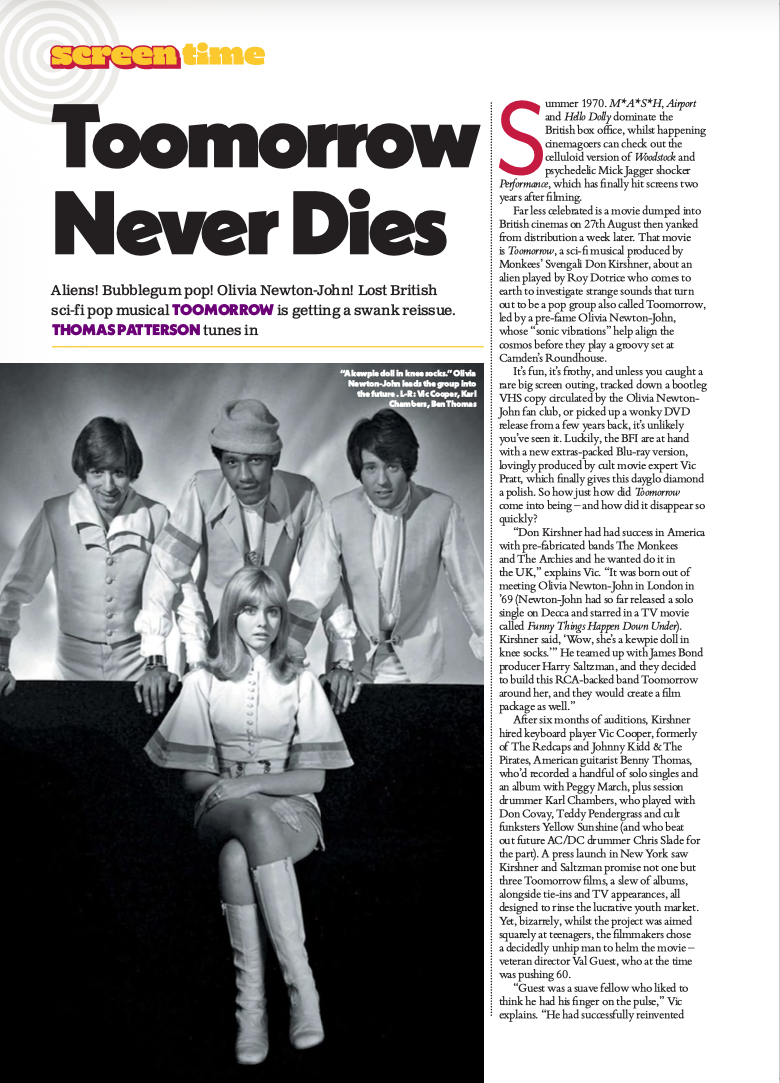
Aliens! Bubblegum pop! Olivia Newton-John! Lost British sci-fi pop musical TOOMORROW is getting a swank reissue. Thomas Patterson tunes in
Summer 1970. M*A*S*H, Airport and Hello Dolly dominate the British box office, whilst happening cinemagoers can check out the celluloid version of Woodstock and psychedelic Mick Jagger shocker Performance, which has finally hit screens two years after filming.
Far less celebrated is a movie dumped into British cinemas on 27th August then yanked from distribution a week later. That movie is Toomorrow, a sci-fi musical produced by Monkees' Svengali Don Kirshner, about an alien played by Roy Dotrice who comes to earth to investigate strange sounds that turn out to be a pop group also called Toomorrow, led by a pre-fame Olivia Newton-John, whose sonic vibrations
help align the cosmos before they play a groovy set at Camden's Roundhouse.
It's fun, it's frothy, and unless you caught a are big screen outing, tracked down a bootleg VHS copy circulated by the Olivia Newton-John fan club, or picked up a wonky DVD release from a few years back, it's unlikely you've seen it. Luckily, the BFI are at hand with a new extras-packed Blu-ray version, lovingly produced by cault movie expert Vic Pratt, which finally gives this dayglo diamond a polish. So how just how did Toomorrow come into being and how did it disappear so quickly?
Don Kirshner had had success in America with pre-fabricated hands The Monkees and The Archies and he wanted do it in the UK,
explains Vic. It was born out of meeting Olivia Newton-John in London in 69 (Newton-John had so far released a solo single on Decca and starred in a TV movie called Funny Things Happen Down Under). Kirshner said, 'Wow, she's a kewpie doll in knee socks.' He teamed up with James Bond producer Harry Saltzman, and they decided to build this RCA-backed band Toomorrow around her, and they would create a film package as well.
After six months of auditions, Kirshner hired keyboard player Vic Cooper, formerly of The Redcaps and Johnny Kidd & The Pirates, American guitarist Benny Thomas, who'd recorded a handful of solo singles and an album with Peggy March, plus session drummer Karl Chambers, who played with Don Covay, Teddy Pendergrass and cult funksters Yellow Sunshine (and who beat out future AC/DC drummer Chris Slade for the part). A press launch in New York saw Kirshner and Saltzman promise not one but three Toomorrow films, a slew of albums, alongside tie-ins and TV appearances, all designed to rinse the lucrative youth market.
Yet, bizarrely, whilst the project was aimed squarely at teenagers, the filmmakers chose a decidedly unhip man to helm the movie veteran director Val Guest, who at the time was pushing 60.
Guest was a suave fellow who liked to think he had his finger on the pulse,
Vic explains. He had successfully reinvented himself over the course of his career. He was making Will Hay films in the 30s, then he started making tough thrillers like The Day The Earth Caught Fire. By the late 60s, he was shooting episodes of The Persuaders. There's this sense he was putting off getting his pipe and slippers and trying to stay in with the groovy set.
Yet you can tell Tomorrow is as fake as it comes in terms of understanding the youth movement; but that's what makes it such a beautiful, kitsch artefact. It's very much an old guy's vision of how teens are supposed to act, how outrageous they're supposed to be. But really, being outrageous means they just want to dance all day. They don't want to take drugs or get drunk. It's a very clean vision.
Toomorrow's songs were written by Ritche Adams and Mark Barkan, who'd penned tracks for The Archies and The Banana Splits (Barkan had also produced cult '66 album Psychedelic Moods by The Deep), sitting alongside a score by composer Hugo Montenegro. When The Monkees were doing their stuff, all these Brill Building songwriters were fighting to get their tracks onto their records,
says Vic. Whereas in Tomorrow's case, Kirshner just hired two mates of his. The library music by Hugo Montenegro is terrific, but the actual tracks are a bit of a damp squib. Nonetheless, it's fascinating, because this is what happens when you don't get that formula quite right.
Shindig! begs to disagree with Vic a little - we love the soundtrack, jam-packed as it is with gloriously sunshiny earworms with upbeat titles like Happiness Valley
. It is true, however, that Adams and Barkan' buoyant tunes were more than a little old hat when the film was initially released. There's another band that come on before Toomorrow when they play at The Roundhouse called Sam Apple Pie, and they sound way more authentic. Then Toomorrow come on and they're wearing outfits like The Osmonds. It's really peculiar to see the Roundhouse, such a counterculture space at that time, and this bubblegum pop thing wheeled out onto the stage and all the kids acting like it's great.
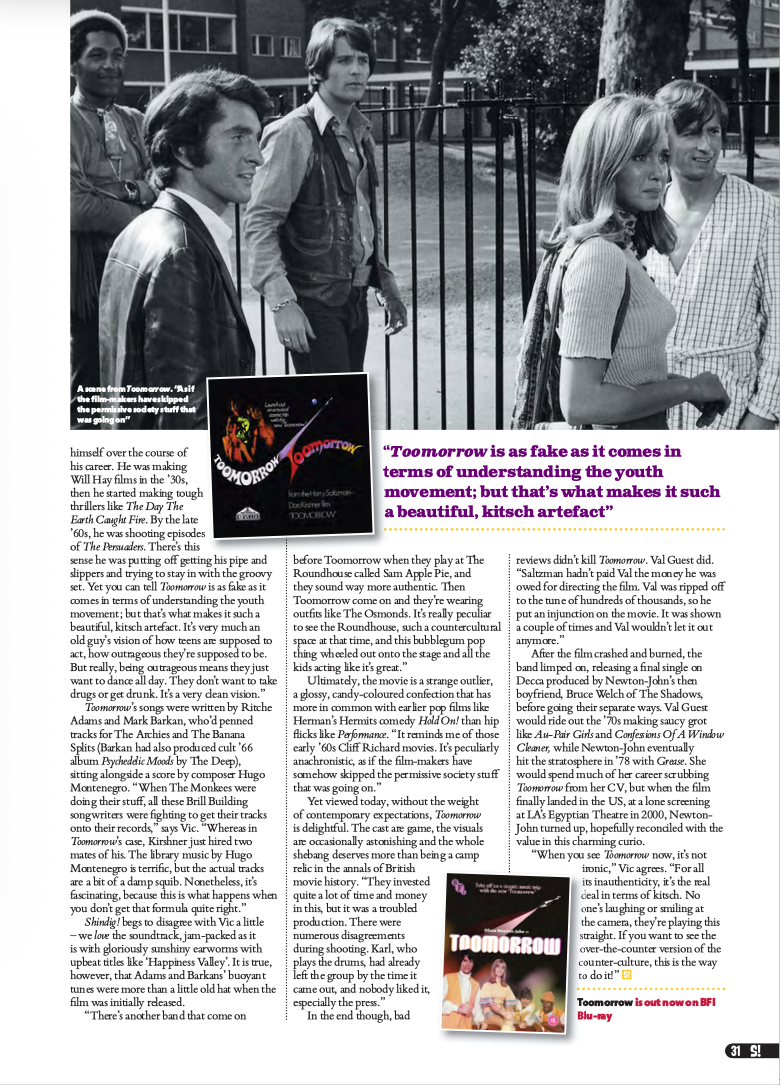
Ultimately, the movie is a strange outlier, a glossy, candy-coloured confection that has more in common with earlier pop films like Herman's Hermits comedy Hold On! than hip flicks like Performance. It remind me of those early '60s Cliff Richard movies. It's peculiarly anachronistic, as if the film-makers have somehow skipped the permissive society stuff that was going on.
Yet viewed today, without the weight of contemporary expectations, Toomorrow is delightful. The cast are game, the visuals are occasionally astonishing and the whole shebang deserves more than being a camp relic in the annals of British movie history. They invested quite a lot of time and money in this, but it was a troubled production. There were numerous disagreements during shooting. Karl, who plays the drums, had already left the group by the time it came out, out, and nobody liked it, especially the press.
Toomorrow is as fake as it comes in terms of understanding the youth movement; but that's what makes it such a beautiful, kitsch artefact
In the end though, bad reviews didn't kill Tomorrow, Val Guest did. Saltzman hadn't paid Val the money he was owed for directing the film. Val was ripped off to the tune of hundreds of thousands, so he put an injunction on the movie. It was shown a couple of times and Val wouldn't let it out anymore.
After the film crashed and burned, the band limped on, releasing a final single on Decca produced by Newton-John's then boyfriend, Bruce Welch of The Shadows, before going their separate ways. Val Guest would ride out the 70s making saucy grot like Au-Pair Girl and Confessions Of A Window Chaser, while Newton-John eventually hit the stratosphere in '78 with Grease. She would spend much of her career scrubbing Tomorrow from her CV, but when the film finally landed in the US, at a lone screening at LA's Egyptian Theatre in 2000, Newton-John turned up, hopefully reconciled with the value in this charming curio.
When you see Toomorrow now, it's not ironic,
Vic agrees. For all its inauthenticity, it's the real deal in terms of kitsch. No one's laughing or smiling at the camera, they're playing this straight. If you want to see the over-the-counter version of the counter-culture, this is the way to do it!
Toomorrow is out now on BFI Blu-ray.